


How do you make sure your online store gets along with your internal systems, or more precisely, with your executive information system (EIS)? How does data from your ERP, PIM, etc. get into the store? This is a good moment to think about your data strategy.
Headless commerce is a piece of cake
Headless commerce means separating the store frontend from the store backend. A layer cake can also be roughly divided into three parts. At the top of the cake, strategy and design processes are key, so that customers are met right where they are. The store frontend is the visible part of an online store, i.e. the user interface for end customers. The store backend is the bottom layer of the cake, where all the data and information the frontend needs is stored. In the middle of the cake sits the sweetest part, the delicious jam: the layer that connects the frontend with the backend.

In headless commerce, the store frontend and the store backend are decoupled from each other. This separation is achieved through APIs. The API-first approach makes it easier for the store frontend to communicate with all relevant frontend and backend systems. In practice, this means an API lets you connect an online store to other software, such as accounting, logistics or warehouse management software. This way you expand the functionality of your online store: you bring the capabilities of the connected application into your store system.
The big three in middleware
An online store runs on data. Whether it's product data or customer data, it often comes from several different systems. The frontend needs specific information that often originates from various sources and can't simply be passed through to the frontend one-to-one. Middleware makes sure this information is delivered from a central point, according to the right criteria and in the right format. Three key processes come together in middleware: collecting, connecting and distributing. Data is collected in the middleware, linked together and finally distributed. That sounds fairly simple, but in reality the process is quite complicated. It's also important to know that data is always edited or changed at the source, never in the middleware.
The most important data sources for an online store
Customer Relationship Management (CRM)
CRM systems are valuable for an online store's marketing, sales and customer service, for example. When the CRM and the store are connected, the user experience improves because customers see more relevant products, for instance, and the customer's current data is used during checkout.
Enterprise Resource Planning (ERP)
An enterprise resource planning system is an information and management system for running business processes in logistics, finance and administration. Connecting the ERP to the online store makes it possible to integrate order and inventory management with accounting (and CRM).
Product Information System (PIM)
A PIM stores product information in the form of descriptions and images. Product data is often maintained in many different places, which quickly makes it error-prone. Managing this data in a PIM provides better visibility and control over it.
Administration or accounting (if not in the ERP)
When accounting is linked to the online store, far less data has to be entered manually. The integration ensures, for example, that orders are recorded in the administration system immediately. This not only saves time but also prevents accounting errors.
Warehouse management (if not in the ERP)
For smooth operations, the warehouse system needs to be connected to the online store. That way, stock levels can be displayed in the store in real time, orders can be placed with suppliers automatically, and inventory is always up to date and synchronized everywhere.
Parcel delivery
Parcel carriers often provide an API that lets an online store communicate directly with the carrier's system. This allows parcels to be tracked automatically and lets customers specify where they want to pick up the parcel or have it delivered.
Data: input and output
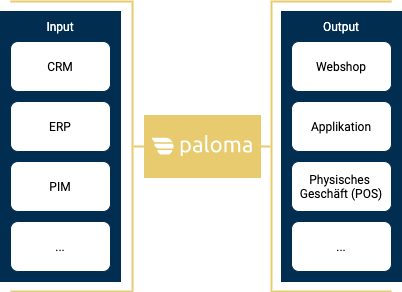
Today, many companies have to deal with multiple systems in which data is stored or from which it has to be retrieved. To complicate matters further, this data is often used not only for the online store but also for other applications, such as a print catalog or a website. One advantage of headless commerce is that the infrastructure can also be used for other "frontends." The data is collected in a middleware layer and can then be distributed to various "frontends" via APIs.
How does this fit into my organization?
Have you concluded that an API-based online store solution could be a good fit for your organization? Then it's wise to map out what such an implementation would mean for the rest of your applications and your digital landscape.
An API-based online store solution can establish connections wherever needed and send information to the input and output channels that exist in your digital landscape. The existing systems in your organization serve as inputs that the middleware accesses. The middleware is the central hub for all data and passes it on to every possible output channel.
At Astina, we build solutions for mid-sized to large companies, and integrating different systems often plays a role in that work. Do you have questions about, or are you interested in, an API-based online store solution? We at Astina are happy to help. Our product Paloma offers an integrated microservice solution for modern B2C and B2B businesses.
Header image: Photo by Caitlyn de Wild on Unsplash